Ship Maintenance
Cooling on a marine main engine runs in two circuits. A closed fresh-water circuit takes the heat directly off the engine, and a heat exchanger passes that heat to a sea-water circuit drawn from outboard and discharged again. The two sides fail in different ways: the fresh-water side is a closed loop, where trouble usually traces back to the condition of the coolant itself, while the sea-water side is in constant contact with seawater and what it carries, so its passages foul and corrode. Once heat transfer on the sea-water side falls off, the fresh-water side can no longer shed its heat, and the engine's working temperature rises in consequence.
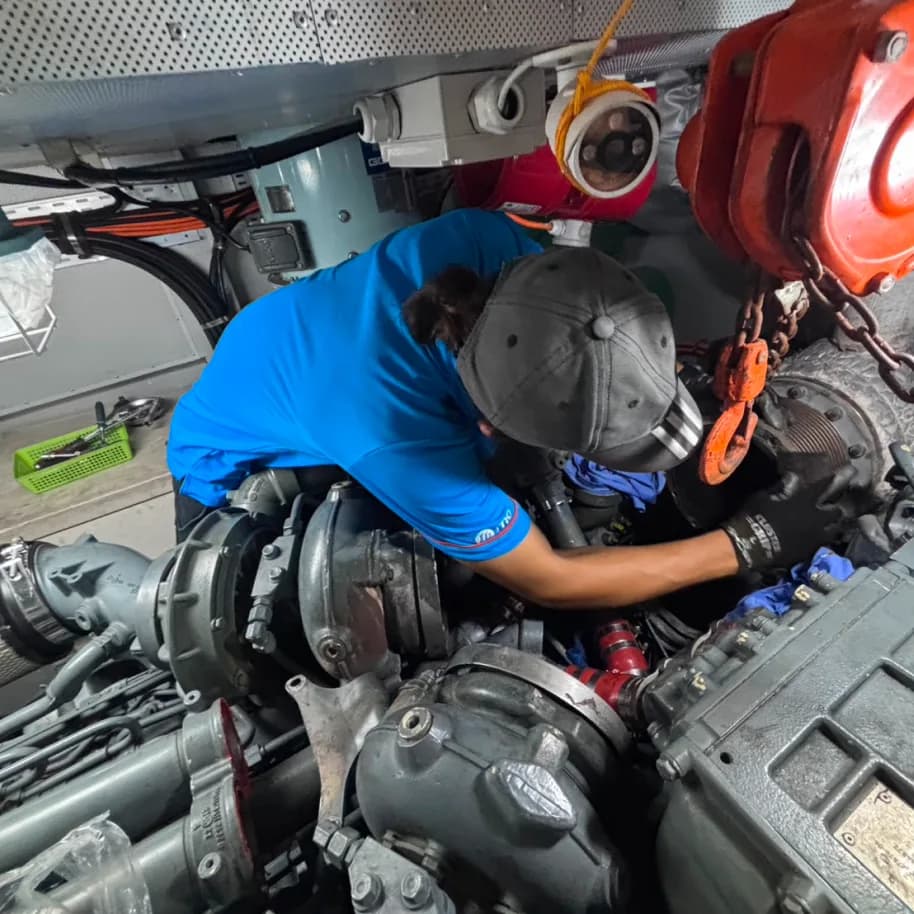
The work covers stripping and inspecting both circuits, cleaning or replacing heat exchangers and pipework, renewing hoses, couplings and other items that degrade in service, and confirming operation once everything is back together. The work is carried out in the space the engine room already has; heavier components are moved out to the walkway with lifting gear before being worked on, and surrounding equipment and pipework are protected beforehand. Whether a component is cleaned or replaced is decided from how far fouling and corrosion have gone.